
How “Censorship = Moderation”: The Hidden Reality of Global Digital Surveillance
Imagine sending a message to a colleague, posting an opinion on social media, or searching for a sensitive news topic online—and assuming your digital footprint is private. Decades ago, state-level censorship was obvious: burnt books, blacked-out newspaper lines, and banned broadcasts. Today, silence is enforced far more subtly. Under the banner of digital safety and user protection, censorship = moderation has become the defining operational model of the modern internet. We rarely notice when content vanishes or when reach is restricted because it happens automatically behind sleek user interfaces and automated algorithms.
What began as a necessary effort to purge explicit harm online has quietly evolved into a global architecture for ubiquitous monitoring. Every time we check a box agreeing to terms of service or opt into a platform’s safety settings, we grant implicit permission for constant data collection. This article explores how public perception shifted from fearing state control to inviting private monitoring, how tech platforms operate as decentralized censors, and what steps you can take to safeguard your digital autonomy in an era where censorship = moderation by default.
1. The Linguistic Shift: Rebranding Censorship as Moderation
Language dictates perception. Historically, the word “censorship” invoked imagery of authoritarian regimes suppressing free speech through force. To make content control palatable in open societies, tech companies and regulatory bodies needed a linguistic reframing. Enter “content moderation”—a term that sounds objective, helpful, and essential for public health.
By recasting political or social control as administrative sanitation, platforms transformed controversial suppression into routine platform maintenance.
When internet platforms filter search results, deprioritize specific political viewpoints, or remove accounts without clear recourse, they rarely call it censorship. Instead, they frame it as enforcing “community guidelines” or protecting users from “misinformation.” This rebranding creates a psychological buffer:
- The illusion of safety: Users view moderation as a public service rather than a restriction on discourse.
- Algorithmic opacity: Instead of explicit bans, platforms utilize “shadowbanning” or reach throttling, leaving creators unaware their reach has been artificially suppressed.
- Corporate immunity: Because private platforms govern these spaces, traditional constitutional protections regarding free expression rarely apply.
When censorship = moderation becomes the industry standard, questioning content removal feels like arguing against internet safety itself.
2. Orwell’s Vision Realized: Why We Voluntarily Accept Mass Surveillance
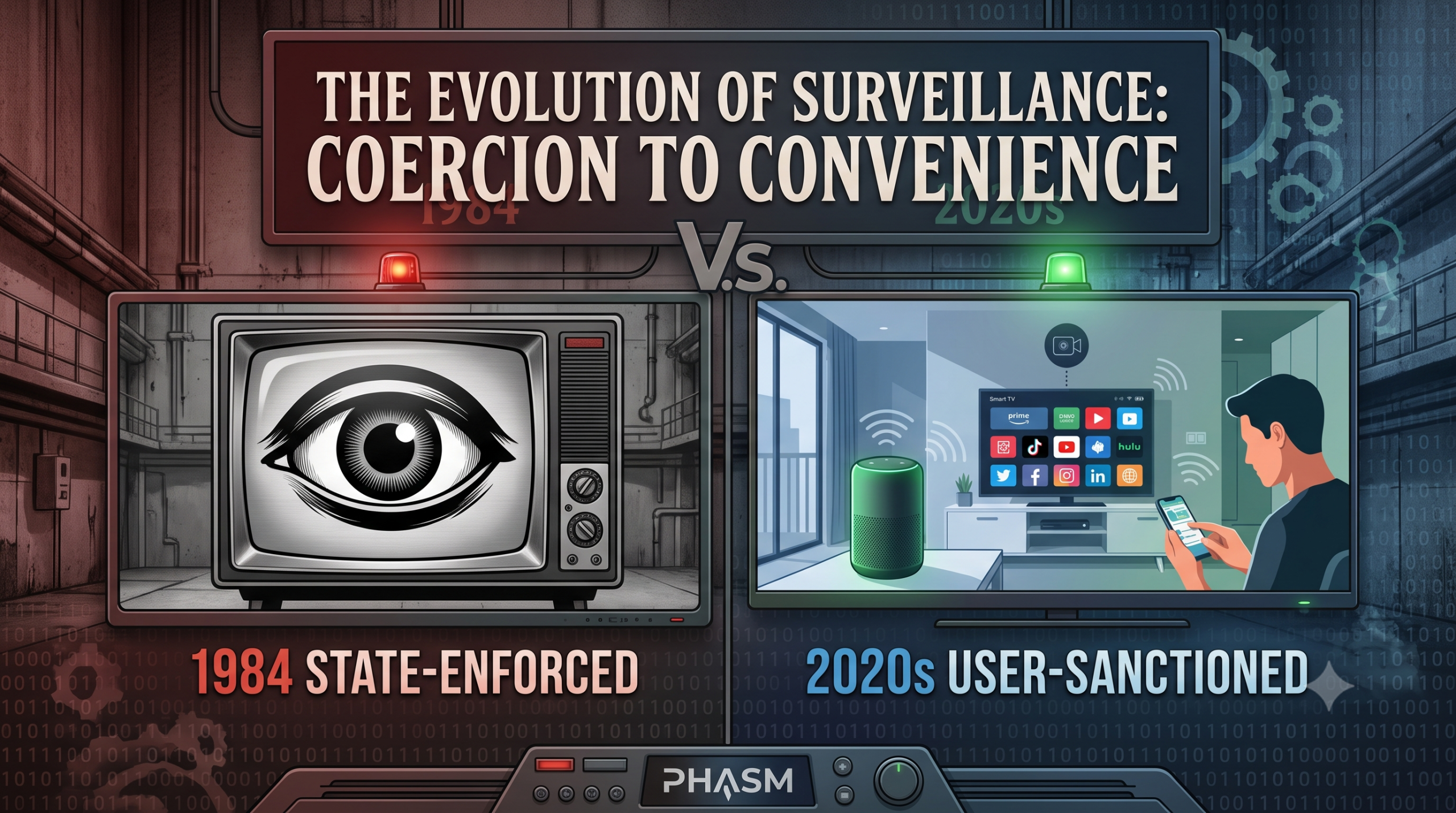
In George Orwell’s 1984, the state enforced compliance through intrusive Telescreens and constant, visible fear of the Thought Police. Citizens were watched against their will. The irony of the 21st century is that we paid for our own Telescreens, carried them around in our pockets, and willingly signed away our data privacy for convenience.
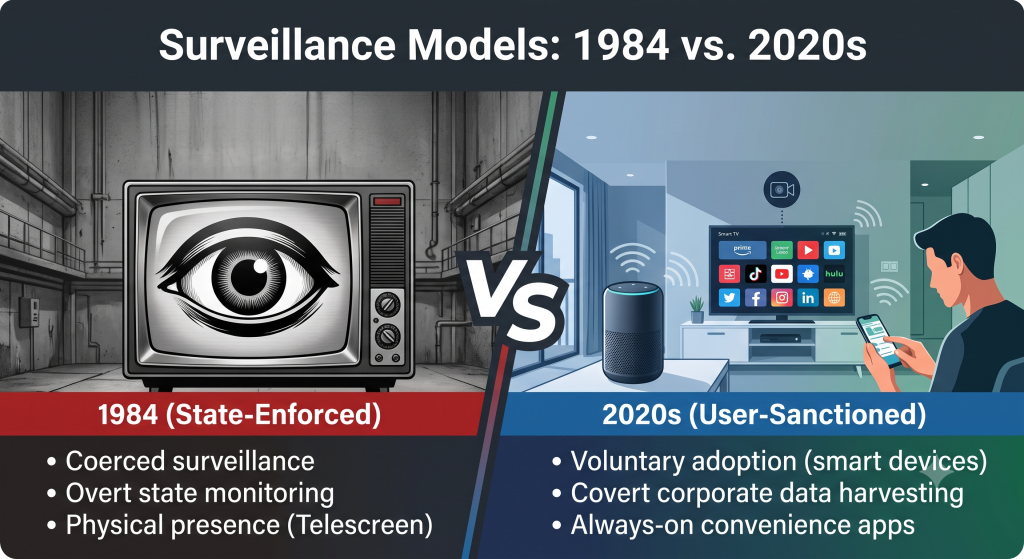
The psychological mechanism behind this acceptance is simple: frictionless utility. We surrender location data, browsing habits, and private communications in exchange for map directions, targeted recommendations, and instant messaging. Over time, this normalized access builds a global surveillance apparatus far more granular than anything Orwell imagined.
The Feedback Loop of Modern Surveillance
- Data Harvesting: Platforms track every keystroke, hover time, and interaction to build detailed behavioral profiles.
- Predictive Moderation: Machine learning models analyze this behavioral data to predict and suppress “risky” content before it spreads.
- Self-Censorship: As users realize their online behavior is monitored, they change how they speak, searching for alternative spellings or avoiding contentious topics entirely.
The ultimate danger isn’t just that platforms are watching; it’s that constant visibility trains citizens to censor themselves.
3. Global Surveillance and the Decentralized Censor
Modern censorship no longer relies on a single dictator or government office deciding what gets published. Today’s network is decentralized, run by a mix of state regulations, financial institutions, and massive technology monopolies acting as gatekeepers.
Governments increasingly outsource censorship to private tech firms through legislative pressure, such as the European Union’s Digital Services Act or national data localization laws. These regulations legally require platforms to remove flagged content within strict timeframes or face catastrophic financial penalties. To avoid liability, platforms over-moderate, erring on the side of deleting legitimate expression.
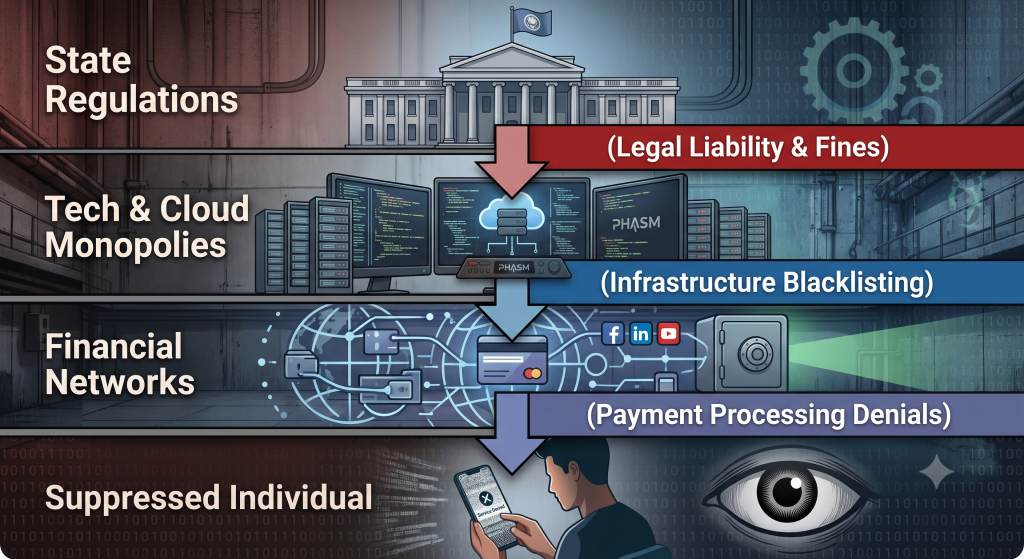
Furthermore, infrastructure-level control means suppression happens deeper in the tech stack:
- Payment Processors: De-platforming individuals by cutting off access to payment gateways.
- Cloud Hosting: Cloud providers revoking hosting services for websites hosting unapproved content.
- App Stores: Mobile ecosystems removing applications that refuse to implement strict internal filtering.
When these layers align, an individual or organization can be effectively erased from modern economic and social life without ever stepping foot inside a courtroom.
4. The Equivalence: Why Censorship = Moderation in the Algorithmic Age
At a technical level, content moderation algorithms make no fundamental distinction between removing illegal content and suppressing disfavored political speech. The mechanism is identical: parsing data inputs against a set of rules and modifying output visibility.
When automated systems are trained to flag content, they operate on mathematical probabilities rather than human context or nuance. This automated dynamic ensures censorship = moderation across every major social platform:
| Aspect | Traditional Moderation | Algorithmic Censorship |
| Scope | Reactive, post-by-post human review | Proactive, system-wide automated filtering |
| Transparency | Clear notice of rules violated | Opaque “reach reduction” or hidden penalties |
| Target | Explicitly illegal or harmful content | Borderline content, political dissent, and satire |
| Accountability | Defined appeal processes | Automated appeals handled by AI systems |
When algorithms dictate what millions of people see based on engagement metrics and safety parameters, public discourse is curated by code. The line separating standard community upkeep from systemic censorship disappears entirely.
5. Practical Application: Reclaiming Digital Autonomy
Navigating an internet where censorship = moderation requires active effort to protect your personal data, minimize surveillance, and maintain independent channels of communication.
Audit Your Digital Footprint
- Minimize Data Exposure: Use privacy-focused browsers like Brave or LibreWolf, and replace default search engines with privacy-centric alternatives like DuckDuckGo or SearX.
- Encrypted Communication: Shift sensitive messaging from standard social media apps to end-to-end encrypted platforms like Signal.
- Review App Permissions: Regularly audit mobile application permissions, revoking location, microphone, and contact access for apps that do not strictly require them.
Diversify Your Information Infrastructure
- Own Your Platform: If you are a creator or business, avoid relying entirely on third-party platforms. Maintain an independent website and self-hosted email newsletter list.
- Decentralized Protocols: Explore federated and decentralized social protocols (such as Nostr or ActivityPub) where no single corporate entity holds the authority to delete your identity or suppress your content.
- Local Data Storage: Back up critical files, documents, and digital assets locally on encrypted external drives rather than relying exclusively on commercial cloud storage.
Rebuilding Trust in a Moderated World
The transformation of censorship into simple “content moderation” represents one of the most significant shifts in information control in human history. By disguising surveillance as convenience and control as safety, the modern web has constructed a system where our daily online activities feed the very mechanisms that limit our freedom of expression.
Understanding that censorship = moderation is the first step toward reclaiming digital independence. Protecting open discourse requires moving away from fragile, centralized ecosystems toward sovereign, resilient technologies that respect user privacy by design.
At Phasm, we build security and privacy solutions designed to give individuals and businesses complete control over their digital infrastructure. Don’t leave your communications, data, and online presence at the mercy of opaque corporate algorithms. Contact the team at Phasm today to learn how our privacy-first tools can secure your digital future.